FAQ
Is GraspPanda only for GraspNet-1Billion or GSNet?
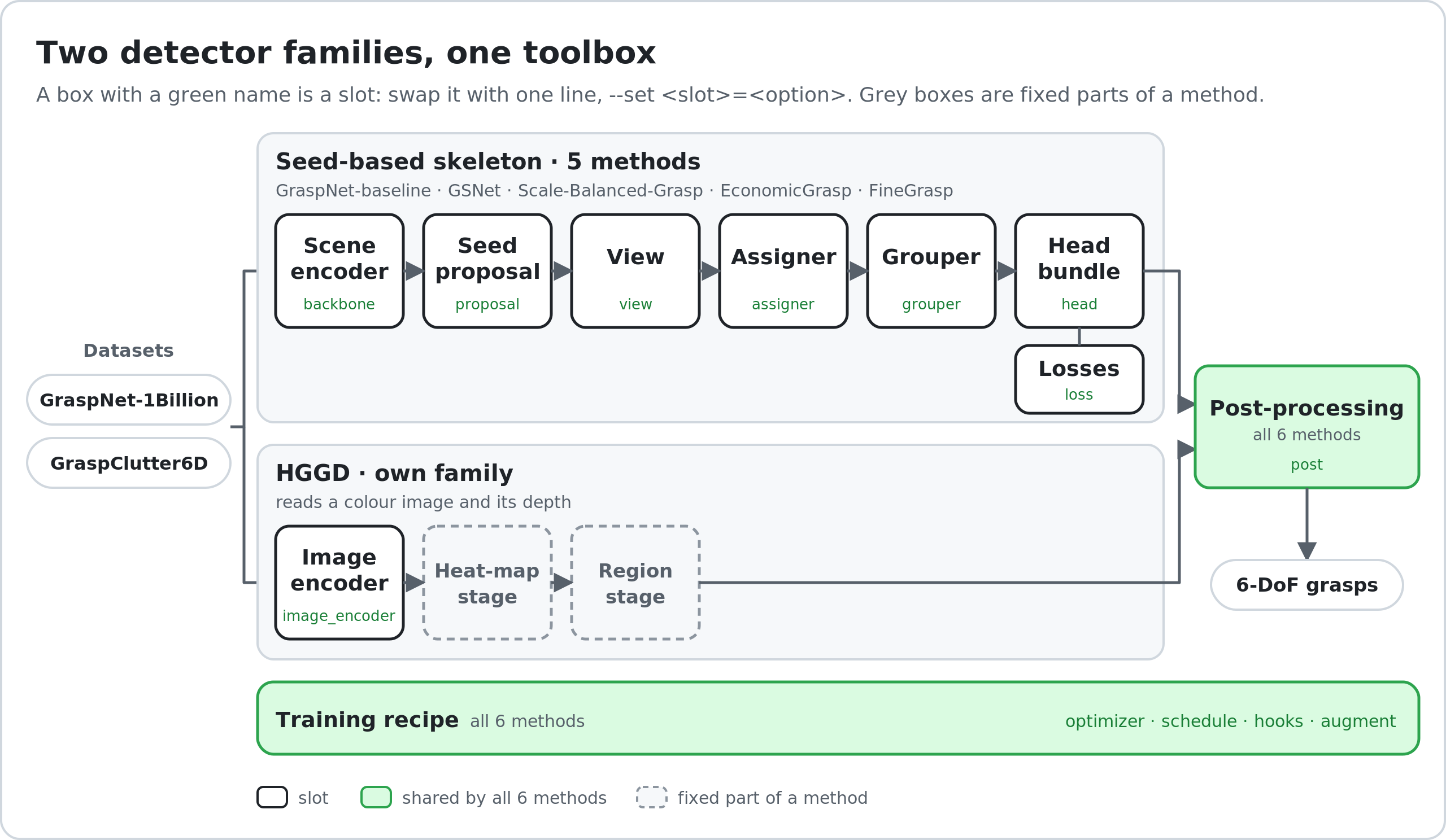
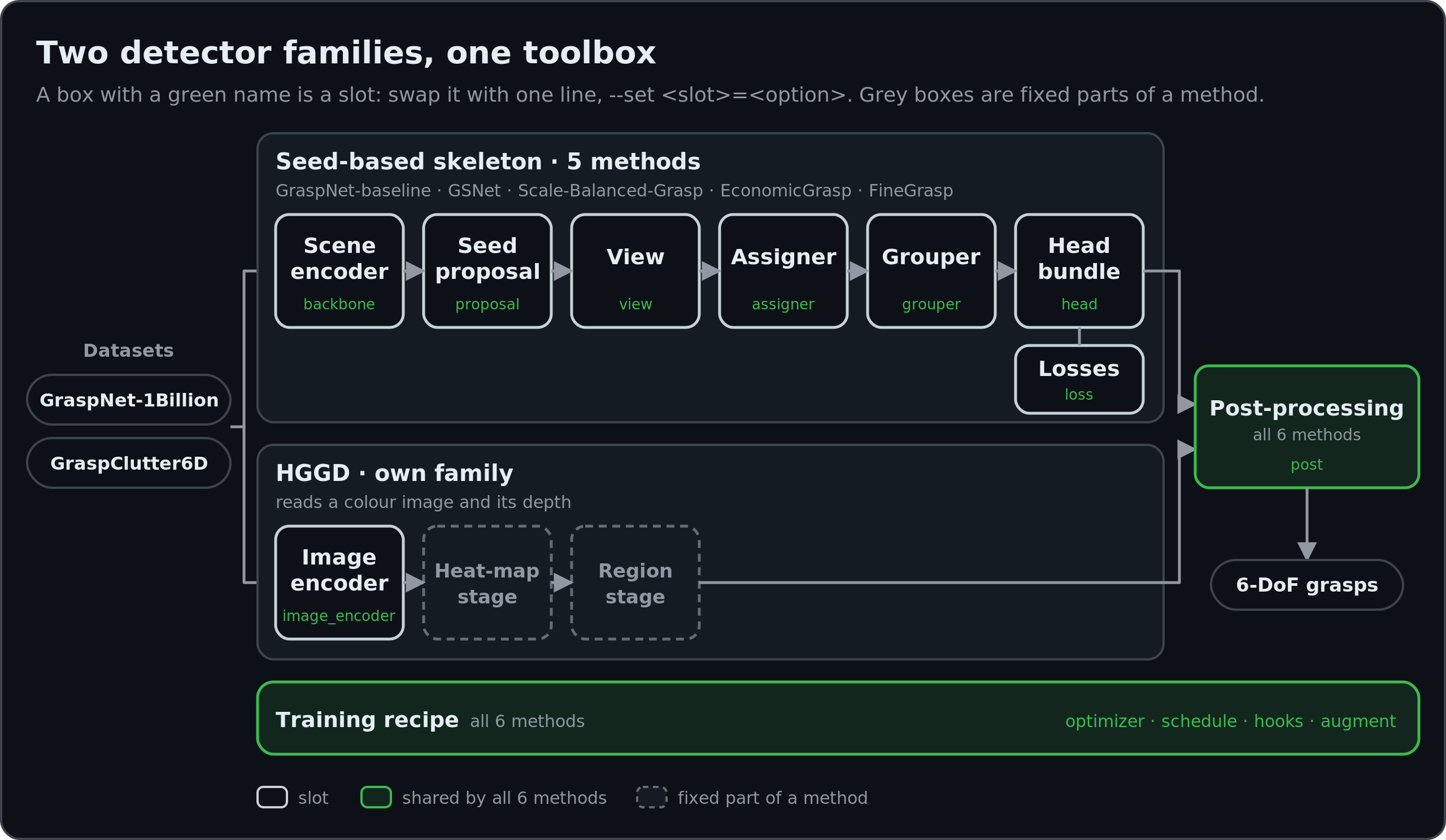
No. GraspPanda starts from GraspNet-1Billion, the benchmark most methods report on, and also reads GraspClutter6D with an evaluator of its own. It ports methods of two families: GraspNet-baseline, GSNet, Scale-Balanced-Grasp, EconomicGrasp and FineGrasp on one seed-based skeleton, and HGGD on its own. GSNet is one of them. Every option shows under which methods it was measured to work: see Methods and Evidence.
Which method should I run first?
The chooser on Run a method shows what each method reads, what it needs installed and where its weights are. GraspNet-baseline, Scale-Balanced-Grasp and HGGD need no extra; GSNet, EconomicGrasp and FineGrasp need spconv (Install).
Does a probe tell me accuracy?
No.
A probe shows that a combination trains on real frames of GraspNet-1Billion, not how good it is. Accuracy is claimed only for a method trained and evaluated here.
A probe trains a combination for a few iterations and says whether it runs, learns and
predicts. Accuracy needs a training on the whole split and grasppanda test; the
model zoo lists what was trained and evaluated here.
Can I download trained weights?
Not from this project yet. Every method runs from weights released with its reference code: you download them yourself, under their licence, and convert them once (Run a method). GSNet was trained here, but its weights are not published yet. A method enters the model zoo only after it has been trained and evaluated here.
Is GraspPanda tied to the Franka Panda robot?
No. The panda is the animal. Grasps are expressed for a generic parallel-jaw gripper in the camera frame; nothing depends on a particular arm.
Why YAML and not Python configs?
Strict validation is far easier to guarantee for data than for code: every key can be
checked against a schema or a constructor signature before anything runs. Logic belongs in
components, which you add through custom_imports without forking.
Why did my override drop some keys?
Changing a node's type replaces the node, so arguments of the old component cannot leak
into the new one. The dropped keys are printed. See
Configuration.
Why does a component not accept **kwargs?
Every config key must be checkable against a signature. A component that swallows arbitrary keys would turn typos into silent no-ops.
Do I need a GPU?
Not for the framework core: every operator has a pure-PyTorch reference implementation and the test suite runs on CPU. Training a grasp detector does need one.
Why is num_workers refused below my TMPDIR?
A data-loader worker hands each batch to the training process through a Unix socket in the
temporary directory, and a socket path may be at most 107 bytes long (103 outside Linux).
Below a deeper TMPDIR the worker cannot create it, drops the batch, and the loader waits
forever. So grasppanda train and test stop at once with the reason. Point TMPDIR to a
shorter directory (TMPDIR=/tmp grasppanda train ...) or set data.train.num_workers=0. A
Python release that falls back to a short directory by itself is recognised and not refused.
How do I report a bug?
Open an issue with the output of grasppanda env and, for a config problem, of
grasppanda print-config <config>.