Run a method
Every ported method runs from its released weights: download the file, convert it once, and get grasps on the example scene in minutes. No dataset is needed.
Which method first?
GraspNet-baseline, Scale-Balanced-Grasp and HGGD need no extra install. HGGD reads a colour image registered to the depth image as well; the others read depth alone.
| Method | Reads | Extra | Weights from |
Licence | Demo |
|---|---|---|---|---|---|
| GraspNet-baseline | depth | none | Google Drive | non-commercial | 10.5 s |
| GSNet | depth | spconv |
Google Drive | non-commercial | 14.8 s |
| Scale-Balanced-Grasp | depth | none | Google Drive | MIT, with non-commercial parts | 10.5 s |
| EconomicGrasp | depth | spconv |
GitHub release | MIT, with non-commercial parts | 14.0 s |
| FineGrasp | depth | spconv |
Hugging Face | Apache-2.0 | 14.8 s |
| HGGD | RGB-D | none | Tsinghua Cloud | MIT | 14.5 s |
- Extra:
spconvis installed as the extra that matches your PyTorch:spconv-cu118,spconv-cu121,spconv-cu124,spconv-cu126,spconv-cpu. - Licence: hover for the full text; each method page states it in full.
- Demo is the whole
grasppanda demo … --examplecommand, measured on one NVIDIA RTX A6000 shared with other jobs; no run was timed on a CPU. - Every checkpoint was trained on GraspNet-1Billion, whose data and labels are under CC BY-NC-SA 4.0.
The example scene
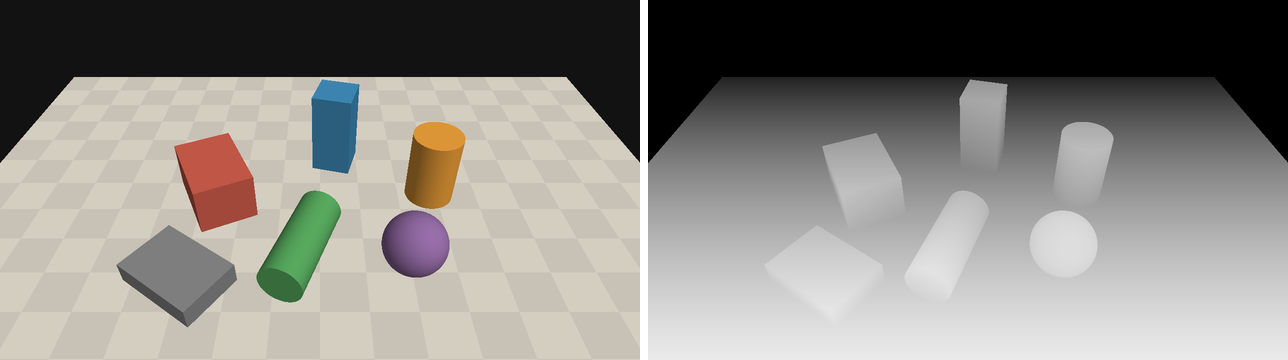
--example is a synthetic table-top scene that ships with GraspPanda: six geometric
primitives on a table, ray-cast into a 1280 × 720 depth image in millimetres, with a
colour image, the camera matrix and an object mask.
- It is computed from formulas, so it needs no download and carries no dataset licence.
- It is not a camera image: surfaces are perfectly smooth, with no noise, no missing depth and no reflection. Every method was trained on real scenes, so the example is outside its training distribution.
- It has no grasp labels, so nothing checks the quality of the predicted grasps. It shows that the installation and the weights work end to end.
Pick a method
Each page walks you through it: the weights and their licence, the conversion, the demo, the same from Python and in the browser, and a first number on the benchmark.
-
GraspNet-baseline · CVPR 2020 · seed-based
The benchmark's own baseline: a PointNet++ encoder, approach views and cylinder crops.
-
GSNet · ICCV 2021 · seed-based
Finds the points worth grasping first, on a sparse U-Net encoder.
-
Scale-Balanced-Grasp · CoRL 2022 · seed-based
Balances grasps of every width, so thin objects are not drowned out.
-
EconomicGrasp · ECCV 2024 · seed-based
Trains on a compact set of labels with an interaction grouper.
-
FineGrasp · arXiv 2025 · seed-based
Builds on EconomicGrasp with crops at several scales, for delicate objects.
-
HGGD · RA-L 2023 · own family
A heat-map on the colour and depth images guides where to look for grasps.
On your camera
A depth image and its intrinsics are enough. For the seed-based methods, --workspace crops
the cloud to the objects, as they were trained; HGGD reads the whole image and crops no
workspace.
grasppanda demo <method config> --weights <converted file> \
    --depth depth.png --intrinsics fx,fy,cx,cy \
    --workspace -0.25 -0.2 0.35 0.25 0.2 0.8
HGGD also reads the colour image registered to the depth image: add --rgb rgb.png and leave
out --workspace. The methods were trained on GraspNet-1Billion (RealSense D435 and Azure
Kinect); results on other cameras have not been measured. Units, the depth scale and the
usual mistakes: Your own camera.
From Python or in the browser
- From Python:
GraspInferencerruns the demo's pipeline and returns the grasps. - In the browser:
grasppanda explore --weights-dir <folder>runs a method on the example scene or an uploaded depth image.
Next
Swap a component of the method you ran.