Components
GraspPanda builds a grasp detector from stages, and every stage is a slot: a place in the config where one component can be swapped for another with one line, --set <slot>=<option>. Five methods share the seed-based skeleton and its slots; HGGD reads images and has one slot of its own, the image encoder. Post-processing and the training recipe apply to all six methods. In all, 244 options you can --set.
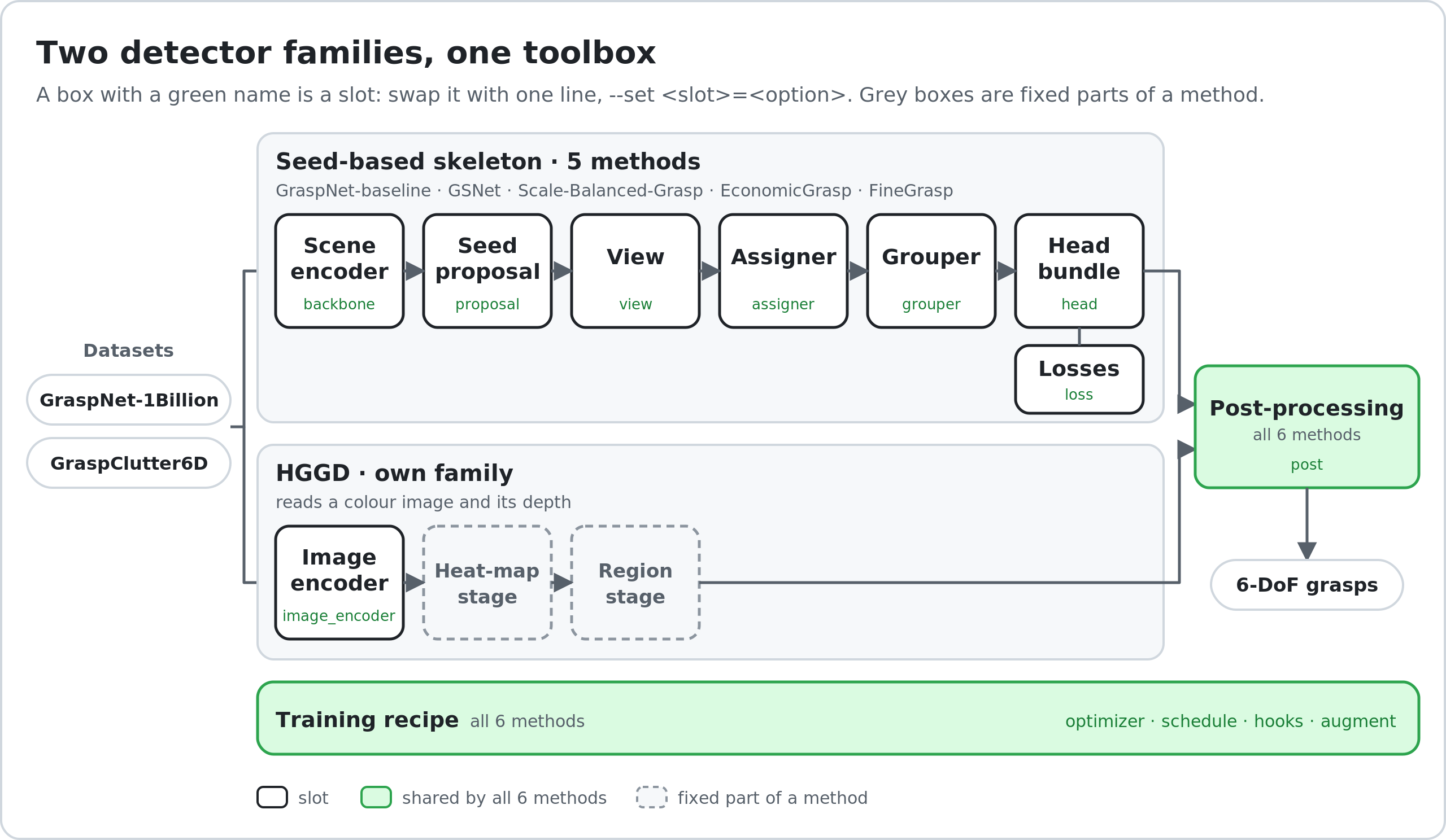
Open the figure at full size: light · dark.
Which method has which slot
| Slot | GraspNet-baseline | GSNet | Scale-Balanced-Grasp | EconomicGrasp | FineGrasp | HGGD |
|---|---|---|---|---|---|---|
| Image encoder | — | — | — | — | — | ✓ |
| Scene encoder | ✓ | ✓ | ✓ | ✓ | ✓ | — |
| Seed proposal | ✓ | ✓ | ✓ | ✓ | ✓ | — |
| View | ✓ | ✓ | ✓ | ✓ | ✓ | — |
| Assigner | ✓ | ✓ | ✓ | ✓ | ✓ | — |
| Grouper | ✓ | ✓ | ✓ | ✓ | ✓ | — |
| Head bundle | ✓ | ✓ | ✓ | ✓ | ✓ | — |
| Loss | ✓ | ✓ | ✓ | ✓ | ✓ | — |
| Post-processing | ✓ | ✓ | ✓ | ✓ | ✓ | ✓ |
| Optimizer | ✓ | ✓ | ✓ | ✓ | ✓ | ✓ |
| Schedule | ✓ | ✓ | ✓ | ✓ | ✓ | ✓ |
| Hooks | ✓ | ✓ | ✓ | ✓ | ✓ | ✓ |
| Augmentation | ✓ | ✓ | ✓ | ✓ | ✓ | ✓ |
| Recipe | ✓ | ✓ | ✓ | ✓ | ✓ | ✓ |
The slots
-
Turns the colour image into feature maps; HGGD predicts its grasp heat-map from them.
HGGD only 38 options
--set image_encoder= -
One feature vector per point of the depth cloud: what a seed knows before any crop. By family: point-based · sparse-voxel · transformers.
Seed-based · 5 methods 47 options
--set backbone= -
Picks the points of the scene at which grasps are predicted.
Seed-based · 5 methods 24 options
--set proposal= -
Chooses the approach direction of every seed.
Seed-based · 5 methods 21 options
--set view= -
Gathers the points around a seed into the feature the head reads.
Seed-based · 5 methods 28 options
--set grouper= -
The head predicts the grasp at a seed; the assigner matches seeds with labels in training.
Seed-based · 5 methods 10 head bundles · 4 assigners
--set head=--set assigner= -
One term of the loss of a stage, replaced on its own.
Seed-based · 5 methods 20 options
--set <stage>.<term>_loss= -
Filters, selects and corrects predicted grasps before a robot or an evaluator.
All 6 methods 15 options
--set post= -
How weights are updated, how the rate moves, what runs around the loop, how a sample is perturbed.
All 6 methods 17 optimizers · 7 schedules · 7 hooks · 3 augmentations · 3 whole recipes
--set optimizer=--set schedule=…
Find your way
- Will an option work under my method? The explorer shows what was measured for every option under every method, with the command.
- What do runs and trains like shipped mean? How we measure defines every word of the tables.
- Every slot of one method: GraspNet-baseline · GSNet · Scale-Balanced-Grasp · EconomicGrasp · FineGrasp · HGGD.
Words used on these pages
Seed, preset, contract, adapter, label set
- Seed: a point of the scene at which a grasp is predicted; the seed proposal picks them (1024 per frame in each of the five seed-based methods).
- Preset: a small YAML file with a component and settings for table-top depth clouds; its name is what follows
--set <slot>=. - Contract: what a component declares about its input and output.
grasppanda composecompares contracts before anything is built and refuses a mismatch with the fix. - Adapter: a wrapper
composeputs around a scene encoder so that it fits the next stage. - Label set: the grasp labels a head is trained on, dense (every view, angle and depth of a labelled point) or compact (the best grasp per view). A head, its assigner and the dataset section use the same one.