Swap a component
Replace one stage of a method with one line, check it, try it on real frames, then train it. The encoder is the usual first swap.
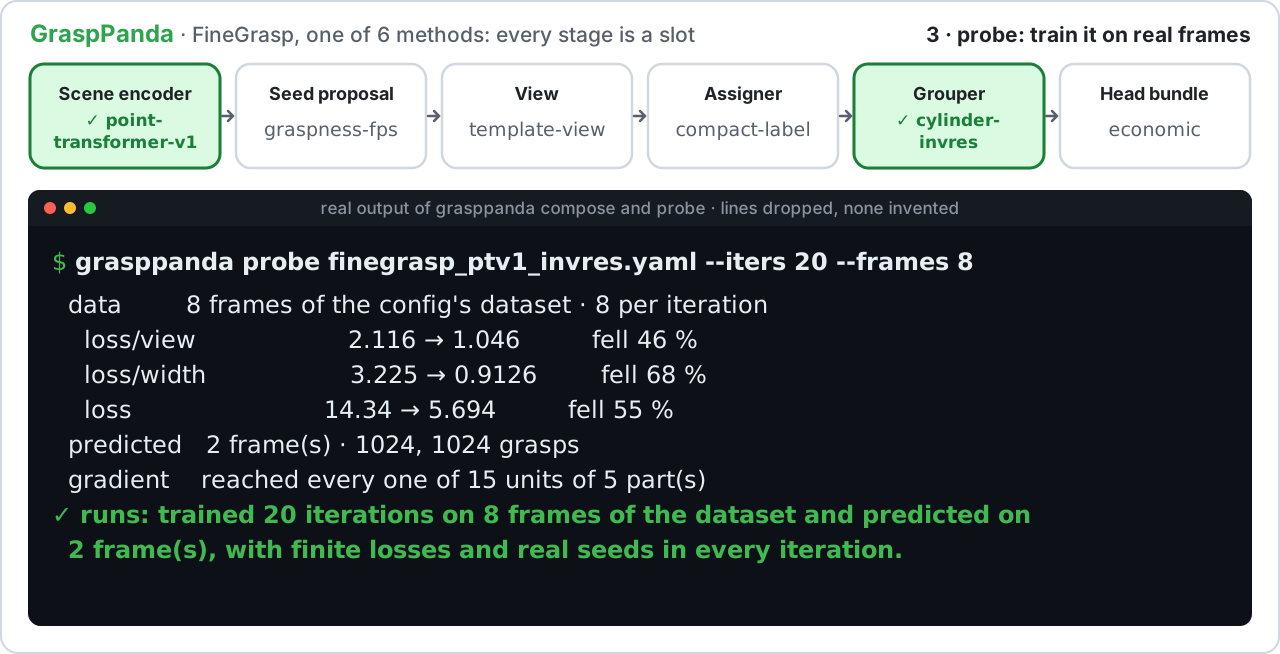
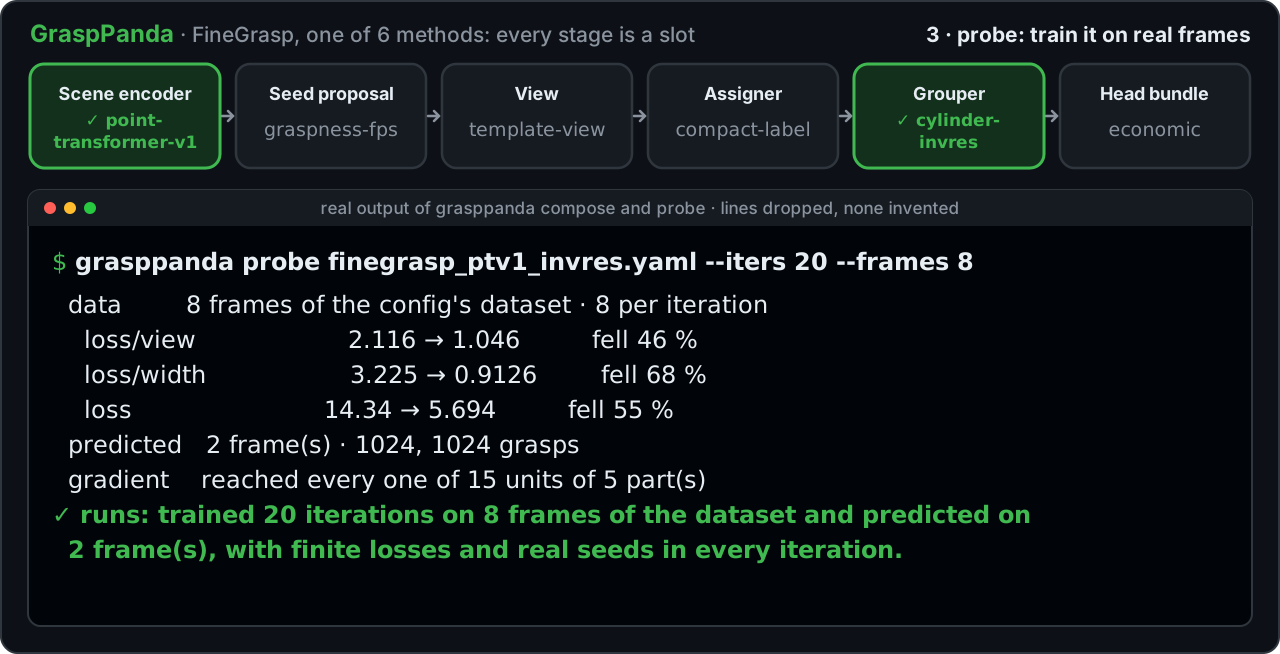
Pick the encoder slot of your method
-
Scene encoder
--set backbone=under GraspNet-baseline, GSNet, Scale-Balanced-Grasp, EconomicGrasp and FineGrasp. For exampleptv3. -
Image encoder
--set image_encoder=under HGGD. For exampledinov2-small-reg-depth-stem.
Every other slot works the same way: all slots. Whether an option works under your method is in the explorer before you run anything.
What you need
| To | You need | You get |
|---|---|---|
| see what works where | nothing: the explorer | the measured record of each swap |
| compose a swap | the install | a checked config, or a refusal with its reason |
probe --synthetic |
the install | wired: the stages connect on a synthetic scene |
| probe on real frames | scene 0 of GraspNet-1Billion and the method's assets for it | one verdict: runs, runs-empty, runs-unstable, fails or refused |
| train | the whole training split, its assets and a GPU | a model with weights, and its AP from grasppanda test |
To probe the examples below, PTv3 needs a spconv extra and the DINOv2 encoder the timm extra
(Install).
1. Compose
grasppanda compose \
    graspnet_baseline/graspnet-baseline_pointnet2_g1b-realsense_18e \
    --set backbone=ptv3 -o baseline_ptv3.yaml
grasppanda compose gsnet/gsnet_sunet14_g1b-realsense_10e \
    --set backbone=ptv3 -o gsnet_ptv3.yaml
grasppanda compose \
    scale_balanced_grasp/sbg_pointnet2-transformer_g1b-realsense_18e \
    --set backbone=ptv3 -o sbg_ptv3.yaml
grasppanda compose economicgrasp/economicgrasp_sunet14_g1b-realsense_10e \
    --set backbone=ptv3 -o economicgrasp_ptv3.yaml
grasppanda compose finegrasp/finegrasp_sunet14_g1b-realsense_10e \
    --set backbone=ptv3 -o finegrasp_ptv3.yaml
grasppanda compose hggd/hggd_r34w8_g1b-realsense_15e \
    --set image_encoder=dinov2-small-reg-depth-stem -o hggd_dinov2.yaml
compose checks every pair of stages and writes the config. Where the next stage needs an
adapter, it inserts one and says so. Most swaps that cannot work are refused with the reason
and the fix, before anything is built; the probe of step 2 catches the rest. --set repeats
for several slots at once.
Why was my swap refused?
Each refusal names its kind: incompatible by design, not supported yet, needs a setting compose adds, needs a preset's settings, or needs your consent. The rules behind them, and the lifts compose applies: Swap rules.
2. Probe
A probe trains the swapped model for a few iterations on real frames, predicts, and ends with
one verdict. Point GraspPanda to your
GraspNet-1Billion download and build the method's assets for the
sample split, a few frames of scene 0:
export GRASPPANDA_GRASPNET1B_ROOT=/path/to/graspnet1b
grasppanda prepare graspnet1b --labels --tolerance \
    --split sample --config baseline_ptv3.yaml
grasppanda probe baseline_ptv3.yaml
export GRASPPANDA_GRASPNET1B_ROOT=/path/to/graspnet1b
grasppanda prepare graspnet1b --labels --graspness \
    --split sample --config gsnet_ptv3.yaml
grasppanda probe gsnet_ptv3.yaml
Scale-Balanced-Grasp also reads a grasp-width histogram of the whole training split,
which a few frames cannot fill. A probe reads the file of the
reference repository
instead (statistic/scale_distribution.npy, written <file> below), in two steps
(What a probe needs).
First add the two --opts that name the file by its SHA-256, and import it once:
export GRASPPANDA_GRASPNET1B_ROOT=/path/to/graspnet1b
sha256sum <file>   # prints the <sha256> of the next command
grasppanda compose sbg_ptv3.yaml -o sbg_ptv3_probe.yaml --opts \
    data.train.dataset.scale_statistic.source=legacy_import \
    data.train.dataset.scale_statistic.reference_sha256=<sha256>
grasppanda prepare graspnet1b --scale-statistic --import-legacy \
    --scale-statistic-file <file> --config sbg_ptv3_probe.yaml
Then build the other assets and probe the config that carries the two --opts:
grasppanda prepare graspnet1b --labels --tolerance \
    --split sample --config sbg_ptv3_probe.yaml
grasppanda probe sbg_ptv3_probe.yaml
export GRASPPANDA_GRASPNET1B_ROOT=/path/to/graspnet1b
grasppanda prepare graspnet1b --labels --graspness --compact-labels \
    --split sample --config economicgrasp_ptv3.yaml
grasppanda probe economicgrasp_ptv3.yaml
export GRASPPANDA_GRASPNET1B_ROOT=/path/to/graspnet1b
grasppanda prepare graspnet1b --labels --graspness --compact-labels \
    --split sample --config finegrasp_ptv3.yaml
grasppanda probe finegrasp_ptv3.yaml
export GRASPPANDA_GRASPNET1B_ROOT=/path/to/graspnet1b
grasppanda prepare graspnet1b --labels --view-grasps \
    --split sample --config hggd_dinov2.yaml
grasppanda probe hggd_dinov2.yaml
grasppanda prepare graspnet1b --check --split sample --config <your config> lists what is
still missing. Without the dataset, the probe runs its synthetic check and reports wired.
A probe shows that a combination trains on real frames of GraspNet-1Billion, not how good it is. Accuracy is claimed only for a method trained and evaluated here.
3. Train
A swapped model has no weights until you train it. Training needs the whole training split with the same assets, and a GPU:
# list what is still missing
grasppanda prepare graspnet1b --check --config <your config>
grasppanda train <your config>
grasppanda test <your config> --weights <run>/checkpoints/best.pth
test scores it with the collision filter on and off. Train and test
has the details, and
Does it train like the shipped component?
shows how swaps that train trained beside the component the method ships.